
Government Gives Drogheda the Two Fingers – Again
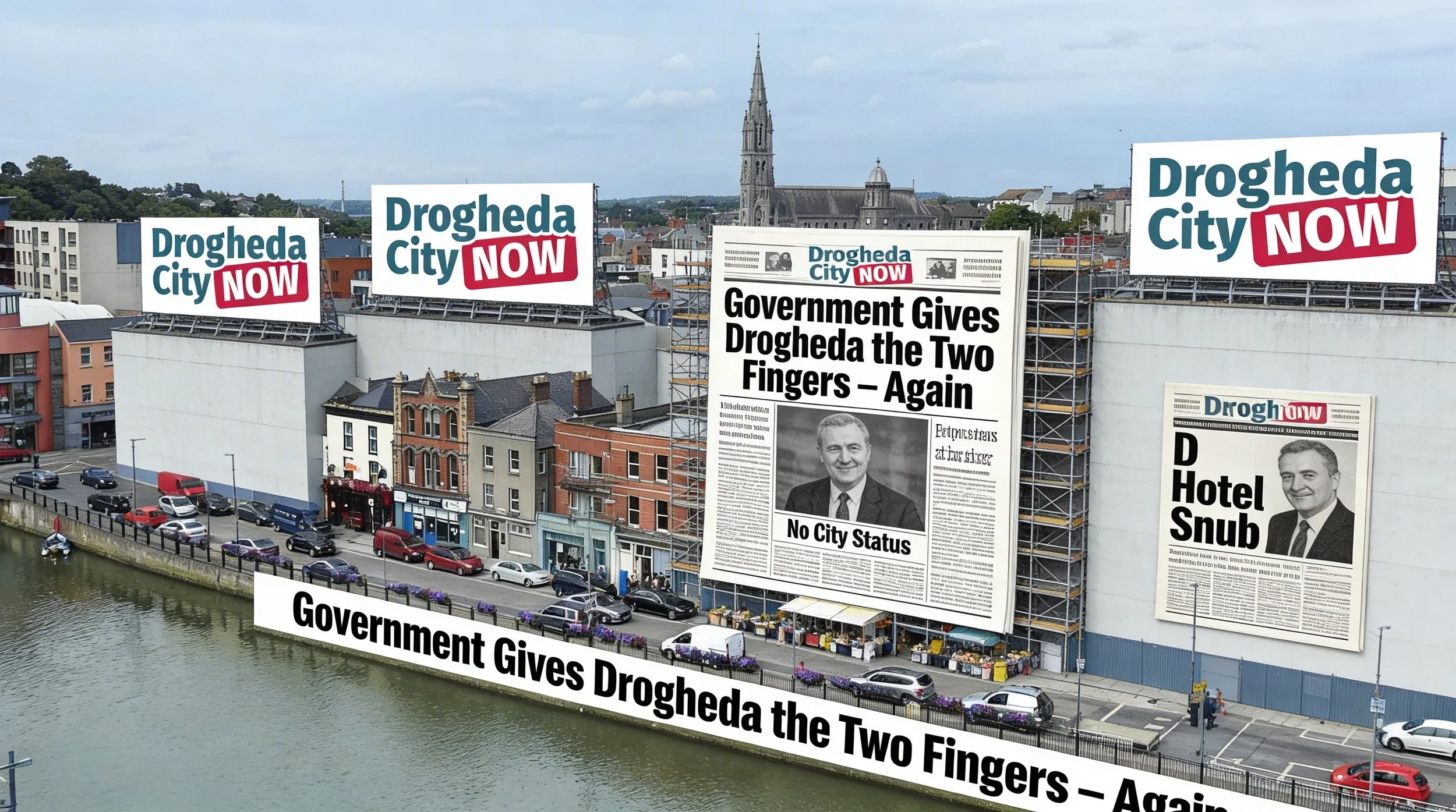
Drogheda has been “given the two fingers once more” by the Government this week, says the Drogheda City Status Group (DCSG).
The city – by every socioeconomic and functional measure already operating at city scale – landed two fresh blows in quick succession:
A Government announcement that no large Irish town will be given city status for the foreseeable future.
A decision that the D Hotel will continue to operate as an International Protection Accommodation Service (IPAS) centre.
No DEIS PLUS for Drogheda Schools
“The appalling neglect and abuse of Drogheda continues,” said DCSG chair Anna McKenna. “We have presented a very strong, evidence‑based case that Drogheda is a city. Yet the Government continues to ignore it, as Drogheda is left abandoned just when we need serious investment and autonomy.”
Drogheda grows while funding stays stuck
“We are being treated woefully by the Government, despite the fact that Drogheda is the fastest‑growing urban area on the island of Ireland,” said Anna.
Drogheda is already Ireland’s fourth‑largest urban area by population, yet it is still administered remotely like a small town. The figures tell a stark story:
Drogheda receives roughly €110 per person in infrastructure funding.
Ireland’s established cities receive about €435 per person.
This underfunding is visible in gridlocked roads, chronic shortages in infrastructure, decades of minimal large‑scale job creation, and widespread dereliction. As one Labour TD put it in 2023 when the city‑status request was batted away, Drogheda needed its own council precisely because it “falls between the two administrative stools” of Louth and Meath; yet the Government has since moved on to other priorities while leaving that core problem untouched.
Empty promises and “two fingers”
The campaign for formal city status, and a dedicated Drogheda administration, has been running since 2010. In recent years, it has gained momentum, with leading Government figures publicly acknowledging Drogheda’s scale. Labour TD Ged Nash once thundered in the Dáil that the Government was giving “two fingers” to Drogheda’s quest for city status – a phrase that now feels almost prophetic, as the same Government that recognised the town’s strategic importance in national planning documents has declined to legislate for a city council.
Just this week, DCSG launched a new community‑led campaign, Drogheda City Now (www.droghedacitynow.com), which brings together residents, businesses, and local partners to secure full city status – and to act like a city while they fight for it. One idea under active discussion is the formation of a “shadow city council”: a local assembly or parliament that would model how Drogheda should be run, demonstrating the appetite for genuine self‑governance.
Overlooked for DEIS Plus Status
Drogheda schools have also been sidelined in education funding. Despite high deprivation indices and rapid population growth, no local primary or post-primary schools qualified for the new DEIS Plus tier introduced in 2025.
This elite category targets the most disadvantaged areas with extra resources like reduced class sizes and literacy supports. Louth schools, including those in Drogheda, missed out entirely, fueling claims of systemic neglect. Campaigners argue this leaves thousands of children without vital supports as the city expands.
From “Drogheda is a city” to “not being considered”
Anna McKenna pointed to the disconnect between rhetoric and reality. “It is clear there is a lack of political will, locally and nationally, to formally recognise Drogheda,” she said. “Drogheda is treated as a dormitory city for Dublin and a cheap solution to the nation’s housing crisis: hundreds of houses are being built, but little else in infrastructure, facilities or job‑creation hubs.”
In 2023, the Minister for Housing, Local Government and Heritage told the Dáil that city‑status legislation for Drogheda was “not being considered at the moment,” even though the National Planning Framework elsewhere calls Drogheda a strategically vital urban centre. The Government has since offered only the restoration of a borough‑style council – a proposal DCSG says “falls far short of what Drogheda actually needs.”
“Enough is enough”
Last month, DCSG representatives met Minister of State John Cummins in the Dáil to lay out the long‑term abandonment of Drogheda. Alongside that, senior figures such as former Tánaiste Micheál Martin and Tánaiste Simon Harris have previously acknowledged Drogheda’s city‑scale potential in public discussions, yet none has moved to deliver the autonomy or local authority structure campaigners say is essential.
“The people of Drogheda must stand up and say ‘enough is enough’,” Anna concluded. “We demand action, not empty promises. Drogheda is already a city in practice; it is time the Government stopped treating us like an afterthought and recognised us as the nation’s newest city in law as well as in reality.”