Historic Cities Bill Introduced in Dáil — Drogheda's City Status Within Reach
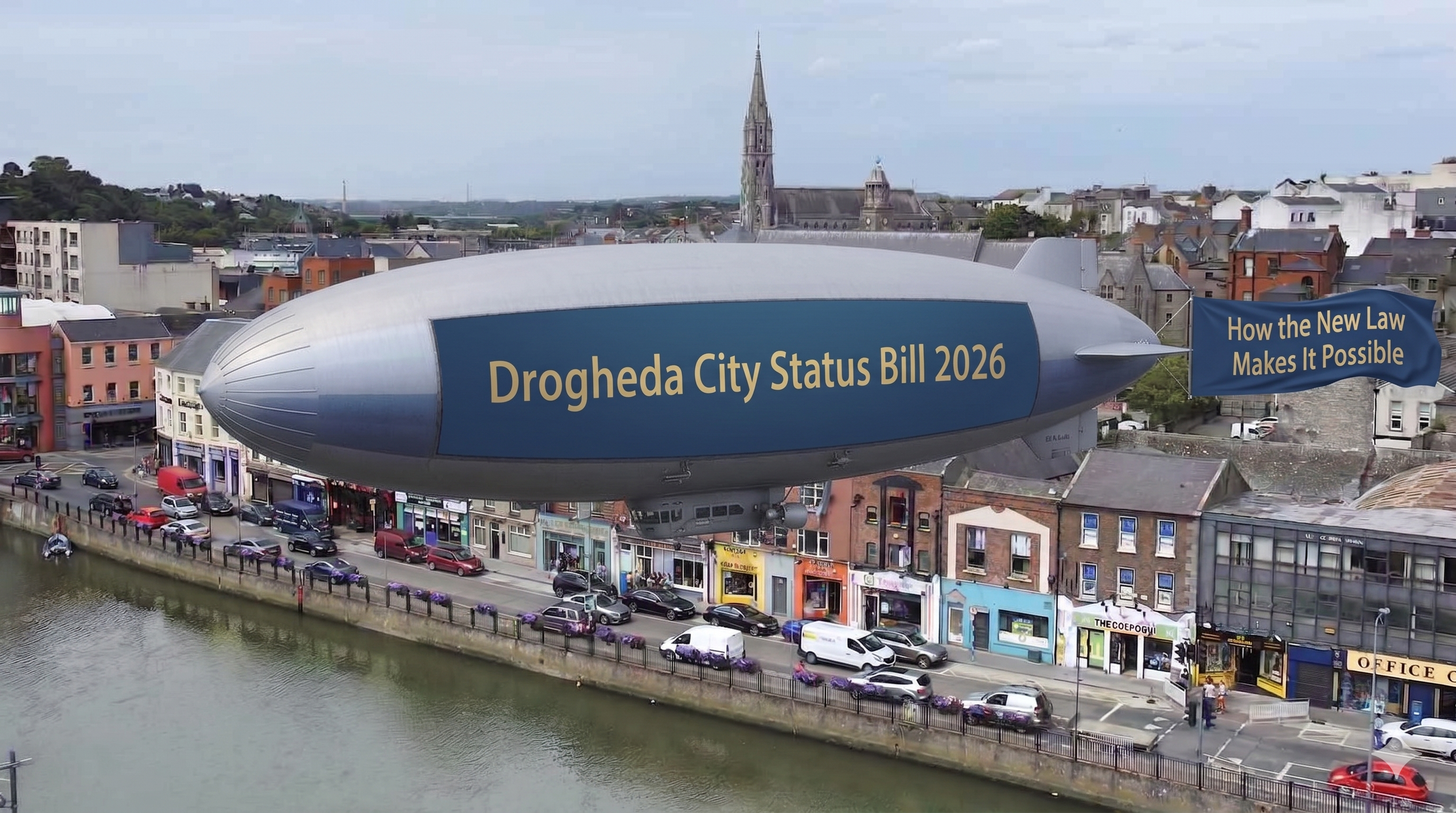
After decades of advocacy and frustration, the breakthrough has arrived. The Local Government (Cities) Bill 2026 has been introduced in the Dáil, creating a clear legal pathway for Drogheda to become Ireland's sixth city — and solving the cross-county barrier that has held us back for generations.
The Moment We've Been Waiting For
On April 29, 2026, Deputy Joanna Byrne introduced Bill No. 18.5 of 2026 — the Local Government (Cities) Bill — to the Dáil. For the first time in Irish legislative history, there is now a formal, codified process for towns to achieve city status based on objective criteria rather than political discretion.
But this isn't just about creating a process. The bill was written specifically to address Drogheda's unique situation: a town of over 50,000 people split between two county councils, with no clear mechanism to unify governance or secure the investment and recognition befitting Ireland's largest urban centre outside the existing cities.
The Numbers:
50,000+ urban population in Drogheda
45,000 minimum population to qualify for city status
6 months maximum timeline from ministerial approval to city status operational
What Makes This Bill Groundbreaking
Section 2: Drogheda Grandfathered as First Cross-County City
The bill explicitly amends the Local Government Act 2001 to designate Drogheda as a city across municipal district areas (plural) — meaning city status can be granted without requiring the Louth-Meath boundary to be redrawn.
"The municipal district areas that... included the Local Electoral Area of Drogheda Urban... shall be known in the Irish language as 'Ceantar Bardasach Chathair Dhroichead Átha' and in the English language as 'the Municipal District of Drogheda City'."
— Section 2(1)(d), Local Government (Cities) Bill 2026
This is the legal innovation that changes everything. Instead of waiting for county boundary reform — a politically fraught process with no timeline — the bill works within the existing structure to grant Drogheda city status on both sides of the Boyne.
Section 4: A Clear Application Process for Future Towns
While Drogheda is named directly in the bill, Section 4 creates a formal pathway for any other Irish town to apply for city status if they meet the following thresholds:
Population: At least 45,000 residents (verified by census data)
Density: Minimum 1,500 people per square kilometre
Coverage: At least 50% of the urban centre's population within the town boundary
Infrastructure: A local civic office or administrative centre providing services
Key Insight: Drogheda is the only town that qualifies today. While Dundalk (37,000) and Navan (33,000) are growing, neither currently meets the 45,000 population threshold. Drogheda's 50,000+ urban population makes it the immediate and obvious beneficiary of this legislation.
The Political Process: How Drogheda Becomes a City
The bill sets out a democratic, multi-stage process that balances local representation with ministerial oversight:
Municipal District Vote: Two-thirds (66%+) of elected members representing Drogheda vote to petition for city status
County Council Review: Chief Executive examines petition and reports to full council
County Council Vote: Majority of councillors vote to support the petition
Ministerial Decision: Minister for Housing reviews petition and supporting evidence, then either grants city status by order or refuses with written reasons
City Status Operational: If approved, city status commences within 6 months of ministerial decision
Projected Timeline to City Status
April 2026 → Bill introduced in Dáil
Q3 2026 → Bill passes Oireachtas, becomes law
Q4 2026 → Act commences (3 months post-passage)
Early 2027 → Council votes and petition submitted
Late 2027 → Drogheda City status granted
Why This Matters: Beyond the Name
City status isn't ceremonial — it's structural. It means:
Dedicated funding streams: Access to urban regeneration funds (URDF), Living City Initiative tax credits, and EU urban development programs currently reserved for cities
Strategic recognition: National planning frameworks prioritize cities as regional growth centres, unlocking transport, education, and infrastructure investment
Governance capacity: City designation strengthens the case for enhanced local authority powers, including potential for a dedicated city council in future reforms
Tourism and economic branding: "Drogheda City" positions the area as a destination and investment hub, leveraging heritage assets (St. Lawrence's Gate, Millmount, Ireland's Ancient East) with city-scale marketing
Civic pride and identity: Official recognition validates what residents already know — Drogheda operates at city scale and deserves to be treated accordingly
The Bottom Line: The bill removes the structural barriers, creates a clear legal pathway, and puts the decision in the hands of local elected representatives. The question is no longer "Can Drogheda become a city?" — it's "When will our councillors vote to make it happen?"
What Happens Next
The bill now progresses through the standard legislative process: committee stage scrutiny, potential amendments, debate in both the Dáil and Seanad, and finally presidential signature. Based on similar legislation, passage by Q3 2026 is realistic.
Once the Act commences (3 months after passage or earlier by ministerial order), the clock starts on Drogheda's application process. This is where community organization becomes critical.
What Drogheda City Now is Doing
Building the evidence base: Compiling population density mapping, heritage documentation, and civic capacity demonstrations (like our Shop Local Festival, Business Directory, and Coffee for Carers initiative) to support the petition
Engaging councillors: Briefing municipal district and county council members on the bill's provisions and Drogheda's qualification criteria
Growing membership: Expanding our base to demonstrate community support — a petition backed by thousands of residents carries more weight than one backed by dozens
Public education: Running information sessions, social media campaigns, and events to ensure every Drogheda resident understands what city status means and how to support it
Join the Movement for City Status
The bill creates the pathway. The community creates the momentum. We need every resident, business owner, and community leader standing together when the time comes to petition.
Become a member:https://www.droghedacitynow.com/membership
Read the full bill analysis:https://www.droghedacitynow.com/drogheda-city-status-bill-2026
A Historic Opportunity — But Not Automatic
The introduction of this bill is a milestone, but it's not the finish line. Even the best legislation requires political will, community pressure, and organized advocacy to translate into real-world change.
That's where you come in.
Over the past decade, Drogheda City Status Group (DCSG) has built the case, produced the evidence, and kept the issue alive through successive governments and councils. Drogheda City Now exists to transform that foundation into a mass movement — one that makes it politically impossible for councillors to vote against city status when the time comes.
Join as a member to be part of the final push. Attend events. Share our content. Talk to your neighbours. Contact your councillors. Every action builds the momentum that turns legislation into reality.
Frequently Asked Questions
Does the Louth-Meath split prevent Drogheda from becoming a city?
No. The bill specifically allows city status to be granted to towns that span multiple county council jurisdictions. Drogheda can become a city across both Louth and Meath without requiring boundary changes. This is the breakthrough provision that makes city status viable.
When could Drogheda officially become a city?
If the bill passes in Q3 2026 and local councils vote in favour, Drogheda could achieve city status by late 2027. The minister must grant city status within 6 months of approving a petition, so the timeline from council vote to official designation is relatively short.
What can I do to help make this happen?
Three things: (1) Join Drogheda City Now to add your voice to the campaign. (2) Contact your local councillors (Louth and Meath) to express support for city status. (3) Participate in community events that demonstrate Drogheda's civic capacity and readiness for city designation.
Will this cost taxpayers money?
City status doesn't inherently require new taxes or levies. What it does is unlock access to existing funding streams (URDF, Living City Initiative, EU urban programs) that are currently reserved for designated cities. The economic argument is that city status brings more investment to Drogheda, not less.
Can other towns follow Drogheda's path?
Yes — that's what Section 4 of the bill enables. Any town meeting the 45,000 population, 1,500/km² density, and civic infrastructure criteria can petition for city status using the same process. Currently, Drogheda is the only town that qualifies, but Dundalk and Navan could reach the threshold within 5-10 years as they continue to grow.
Read the Full Analysis
We've broken down every section of the bill, mapped the qualification criteria, and explained the application process in detail. If you want to understand exactly how this legislation works and what it means for Drogheda, read our full analysis of the Local Government (Cities) Bill 2026: https://www.droghedacitynow.com/drogheda-city-status-bill-2026
The path to city status is now clear. The legislation is in place. The evidence is on our side. The only question is whether we, as a community, will seize this historic opportunity.
Let's make sure the answer is yes.