
Why Louth and Meath Councils May Resist Drogheda City Status
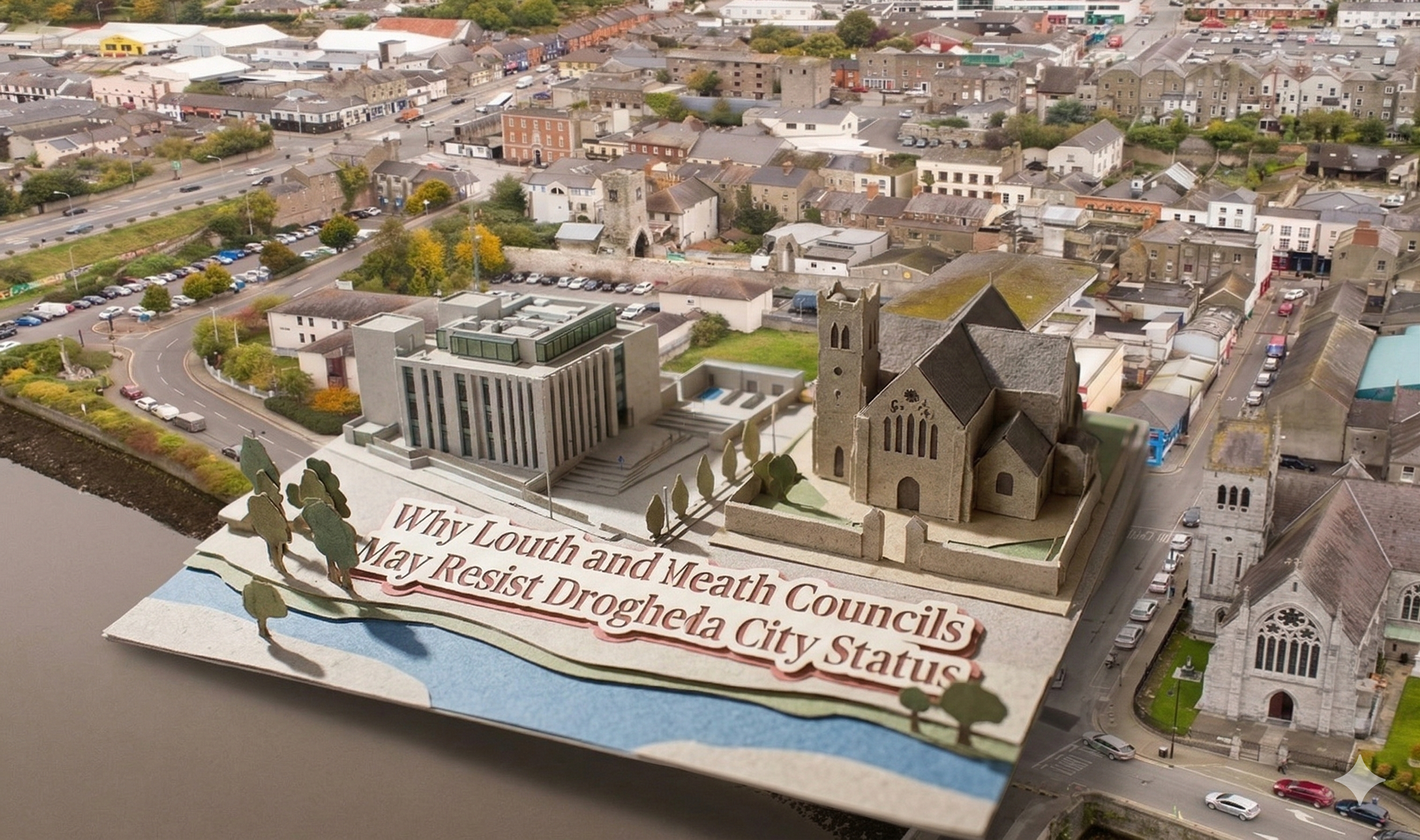
For years, Drogheda has been arguing that it already functions like a city, even if it does not yet have city status in law. It is large, growing, strategically important, and sits at the heart of the Dublin-Belfast corridor. But if Drogheda were to become a separate city with its own council, both Louth County Council and Meath County Council would have reasons to resist it.
At the centre of the issue is power. A separate Drogheda city authority would not just be a symbolic change. It would mean a transfer of responsibility, money, staffing, and political influence away from the two counties that currently oversee the town. For both councils, that is a real loss.
What Louth and Meath Stand to Lose
The most obvious loss is financial. Drogheda is one of the strongest economic and population centres in the region, and a new city council would likely take with it a significant share of rates, grants, service funding, and future development opportunity. That means less money flowing into the county structures that currently manage roads, housing, planning, parks, and community supports across a wider area.
There is also a loss of strategic control. At the moment, Drogheda is governed through county systems where decisions are made alongside other towns and rural areas. If Drogheda became a city, its priorities would no longer be folded into a county-wide agenda. Instead, it could set its own direction, with its own budget, staffing structure, and long-term planning powers. That would leave Louth and Meath with less influence over one of the region’s most important urban centres.
Then there is the staffing issue. If a city split were handled properly, staff should transfer with functions, not disappear. But from the point of view of county councils, the creation of a new city authority still means losing experienced people, institutional knowledge, and direct control over services in the Drogheda area.
Why the Political Resistance Matters
This is not just a financial argument. It is also political.
Louth County Council and Meath County Council both have elected members who represent areas outside Drogheda. If Drogheda becomes a city, the political centre of gravity changes. Decisions that were once made in county chambers could shift to a new city council focused entirely on Drogheda’s urban needs. That means less political control for county-based representatives and less influence over a key growth area.
This is especially sensitive because Drogheda has long been split between two counties. That split weakens the town’s ability to speak with one voice. It also allows the counties to retain influence without fully solving the governance problem. In that sense, resistance to city status can sometimes look less like a policy disagreement and more like institutional self-protection.
The Local Representation Problem
One of the strongest arguments in favour of Drogheda city status is that the town’s interests are not always strongly represented at county or national level. In practice, the town has often lacked a strong set of local political champions.
That matters because major governance changes usually need sustained political pressure. If there are no local councillors or TDs from Drogheda pushing the case consistently, then the issue can be treated as important but not urgent. The result is delay, dilution, and political hesitation.
This creates a structural problem for Drogheda. The town may be large enough to justify city status, but if its political voice is fragmented or weak, the county system has little incentive to let go. In politics, absence of local representation often means weaker leverage in negotiations over funding, services, and reform.
The Fear Behind the Opposition
At heart, the fear is not just that Louth and Meath would lose territory. It is that they would lose a growth engine.
Drogheda is a town with serious economic potential. If it becomes a city and starts attracting more direct investment, stronger branding, and city-level governance, then future growth could move away from county-led structures. That could leave Louth and Meath with reduced returns from an area that already helps drive jobs, housing demand, commuter flows, and commercial activity.
So opposition to Drogheda city status can be understood as a combination of:
Loss of money.
Loss of staff.
Loss of political control.
Loss of influence over regional growth.
Fear of setting a precedent for other towns.
A Fairer Way Forward
The strongest argument is not that Louth or Meath should be weakened. It is that Drogheda should not be held back because of county boundaries that no longer fit reality.
A realistic solution would protect the interests of both counties while allowing Drogheda to grow properly. That means a fair financial settlement, transfer of relevant staff, shared services where needed, and a phased transition rather than a sudden break. It also means making sure Drogheda’s new authority has enough funding and powers to actually improve services, rather than just taking on a new name.
If done properly, city status would not be a punishment for Louth or Meath. It would be a restructuring that reflects the real shape of the region.
Conclusion
Louth County Council and Meath County Council may resist Drogheda becoming a separate city because it would reduce their money, reduce their control, and shift political power away from the county model. The absence of strong local councillors and TDs from Drogheda only makes that resistance easier to sustain.
But the bigger question is not what the counties might lose. It is whether Drogheda can keep growing under a system that no longer matches its scale. If the goal is balanced regional development, then the answer may be to let Drogheda become the city it already is in practice.